About the Student Visa Application
Australia student visa application policy keeps changing for the better.
Prior to COVID, the Australian student visa policy was focus on expansion, where
the system encouraged international enrolment growth
After 2022, the policy focus shifted to migration integrity
Take a look at the timeline below :

This reform causes some consequences for current visa application. Check some facts below :
FACT #1 : Refusal becomes more common
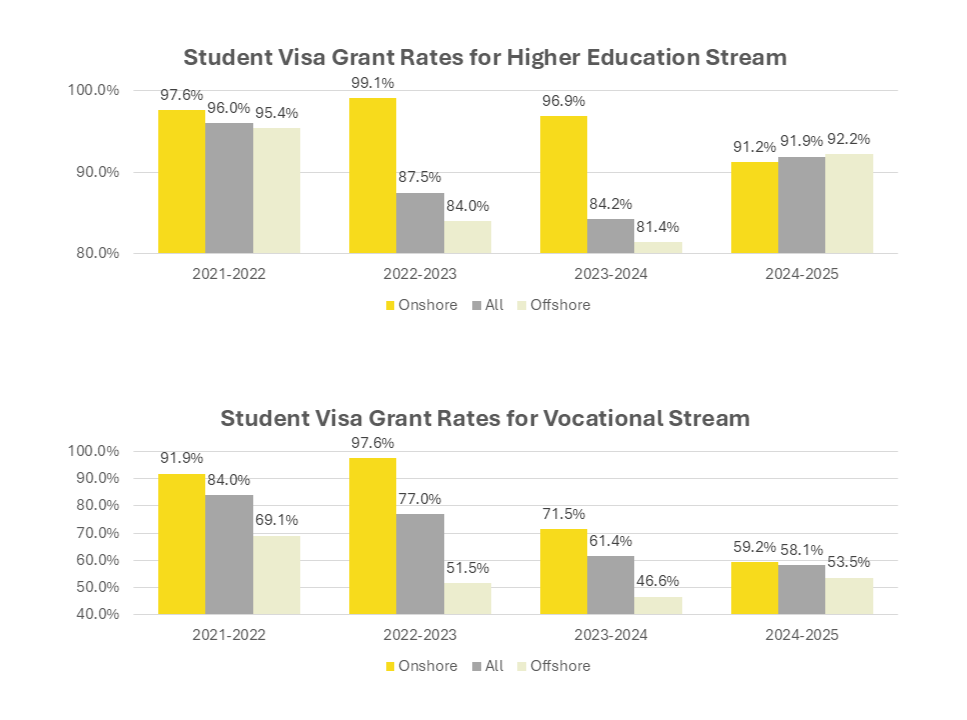
Take a look at the student visa grant rates in the images on the right.
You will notice that started in 2022, there has been substantial reduce in grant rates for student visa, especially in Vocational stream.
Currently, the overall grant rates for vocational stream is below 60%. Some countries with higher risk level even stand below 40%. The higher education however rise to around 90% currently because universities takes drastic roles to filter stronger and more genuine applicants to issue COE.
Also, most onshore applicants generally showing a progression in their study plan pathway.

FACT #2 : Education Providers are very selective
Prior to 2022-2023, education providers did not perform a heavy filtering of highrisk applicants. They rely on agent declarations and basic written statements.
After the reform, education providers carry out some of the Department of Home
Affairs (DHA) tasks to filter genuine applicants through :
- Mandatory GST (Genuine Student Test) Pre-Screening
- Financial Capacity and English Competency verification
- Academic progression and background alignment checks
- High-risk country / nationality filtering
- Deep check on fraud and document verification
- Deep check on historical stay in Australia
This measure is implemented to ensure the integrity of education providers, which can affect their Risk Assessment Level, and their annual allocation number of students enrolled.
FACT #3 : Timing matters !
Understanding the difference of applying onshore vs offshore, and whether education provider quota is nearly full or not, will help youto plan ahead your visa application.
In general, if your visa application is strong and your country /provider level is in low risk, you can get a grant decision quickly (sometimes INSTANTLY !).
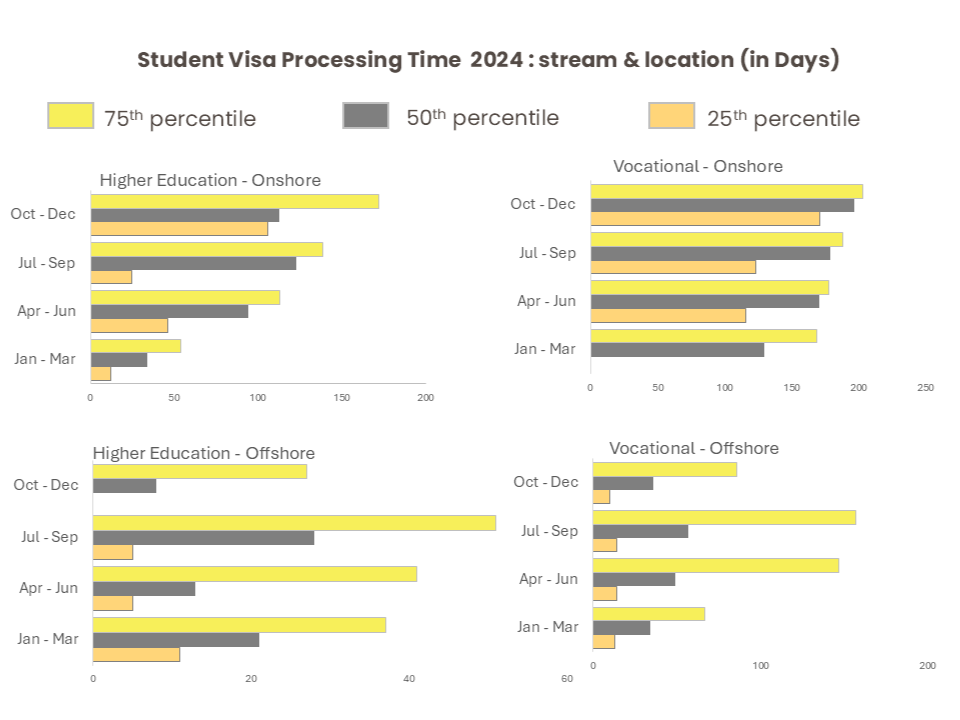
Also, offshore application tends to get processed faster than onshore, as well as higher education stream will be processed faster than vocational application.
If you apply from offshore, your application may access priority lane due to the MD 115 where government streamlined the application process based on the course level and allocation exhaustion.
Compare the data from image on the right to get the idea how long your visa processing will take.